__________________________
Defining niche becomes increasingly complex..
At the outset, niche fragrance brands were defined by the beauty of the small and qualitative: singular categories, artisanship, small-scale production, selective distribution, and independent ownership.
This focus sparked a culture of deep exploration, giving rise to adventurous and innovative scents that breathed new life into an otherwise stagnant industry. Large luxury houses, renowned for their vertically integrated core products like leather goods and high-end jewelry, didn't prioritize fragrances as much, overshadowing the creative processes that later became the greatest strength of niche fragrance brands.
Consequently, perceived authenticity flourished within the niche, albeit constantly tested by the allure of growth through new products, market expansions, or acquisitions, potentially compromising standards, and hence authenticity and identity.
Meanwhile, as niche fragrance brands gradually outgrow their niche label, luxury houses are striving to bridge the gap between them. They do so by introducing leaping collections that imitate the end-to-end production processes, distribution, and marketing strategies of niche brands, creating branded supply chains that highlight creativity and the people driving it.
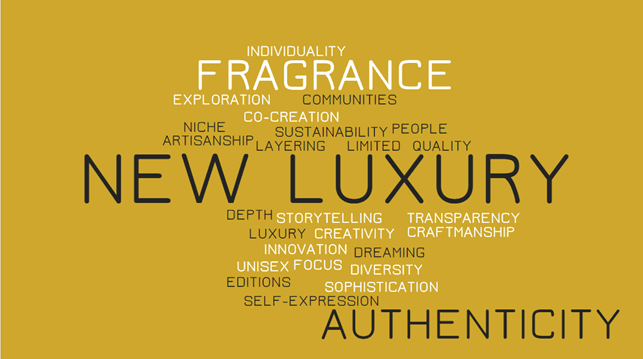
As these definitions are constantly in motion, the distinction between them becomes less important than understanding a new standard:
▪ Perfume has evolved into an accessible luxury, especially enticing to younger consumers. The emergence of innovative scents, brands, and concepts from diverse origins has transformed the fragrance category, offering endless opportunities for exploration, dreaming, and personal expression, signaling not just one's wealth but also knowledge, values, and sophistication.
▪ The trickle-down effect no longer stems solely from the elite but rather from authentic voices within fragrance communities, including social media fragrance influencers, KOLs, and discerning consumers, who meticulously evaluate brands for their authenticity and societal impact, reshaping the narrative surrounding fragrance consumption.
▪ With consumers wielding greater influence in shaping brand narratives, the dynamic between brands and consumers has shifted towards mutual partnerships with consumers now actively involved in brand co-creation.
▪ Transparency in product creation has shifted from being optional to essential, emerging as a competitive advantage for brands that proudly share the stories of how, where, and by whom their products are made.
▪ Gender boundaries are blurring, with unisex fragrances becoming the norm.
▪ Personalized experiences, such as limited editions, unique batch numbers, and layering techniques, now play a crucial role in fulfilling consumers' desires for individuality and self-expression.
▪ Word limit reached...
__________________________

"This is an article I published on LinkedIn that I later removed because I felt it gave away too much away."

Marcus Nymand Jacobsen, Managing Partner


__________________________
Defining niche becomes increasingly complex..
At the outset, niche fragrance brands were defined by the beauty of the small and qualitative: singular categories, artisanship, small-scale production, selective distribution, and independent ownership.
This focus sparked a culture of deep exploration, giving rise to adventurous and innovative scents that breathed new life into an otherwise stagnant industry. Large luxury houses, renowned for their vertically integrated core products like leather goods and high-end jewelry, didn't prioritize fragrances as much, overshadowing the creative processes that later became the greatest strength of niche fragrance brands.
Consequently, perceived authenticity flourished within the niche, albeit constantly tested by the allure of growth through new products, market expansions, or acquisitions, potentially compromising standards, and hence authenticity and identity.
Meanwhile, as niche fragrance brands gradually outgrow their niche label, luxury houses are striving to bridge the gap between them. They do so by introducing leaping collections that imitate the end-to-end production processes, distribution, and marketing strategies of niche brands, creating branded supply chains that highlight creativity and the people driving it.
As these definitions are constantly in motion, the distinction between them becomes less important than understanding a new standard:
▪ Perfume has evolved into an accessible luxury, especially enticing to younger consumers. The emergence of innovative scents, brands, and concepts from diverse origins has transformed the fragrance category, offering endless opportunities for exploration, dreaming, and personal expression, signaling not just one's wealth but also knowledge, values, and sophistication.
▪ The trickle-down effect no longer stems solely from the elite but rather from authentic voices within fragrance communities, including social media fragrance influencers, KOLs, and discerning consumers, who meticulously evaluate brands for their authenticity and societal impact, reshaping the narrative surrounding fragrance consumption.
▪ With consumers wielding greater influence in shaping brand narratives, the dynamic between brands and consumers has shifted towards mutual partnerships with consumers now actively involved in brand co-creation.
▪ Transparency in product creation has shifted from being optional to essential, emerging as a competitive advantage for brands that proudly share the stories of how, where, and by whom their products are made.
▪ Gender boundaries are blurring, with unisex fragrances becoming the norm.
▪ Personalized experiences, such as limited editions, unique batch numbers, and layering techniques, now play a crucial role in fulfilling consumers' desires for individuality and self-expression.
▪ Word limit reached...
__________________________
"This is an article I published on LinkedIn that I later removed because I felt it gave away too much away."
Marcus Nymand Jacobsen, Managing Partner